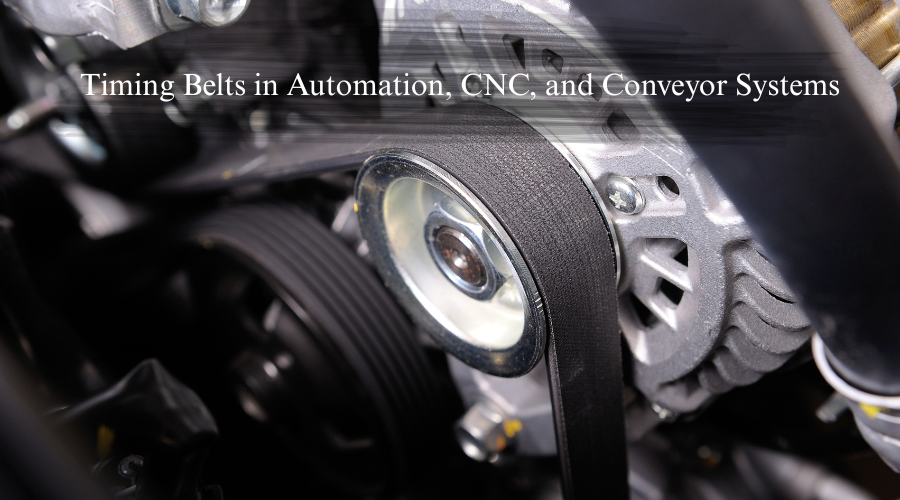
The modern manufacturing industry heavily depends on precise, consistent motion systems. Timing Belts are important for power transmission and movement control in automated equipment.
Such specialized belts differ from standard drive belts; they are designed with teeth to ensure that the positions align and the motion is synchronous. The dynamics of timing belts in leading industries demonstrate their significance in modern-day production.
Basic Design and Function
Timing belts also have teeth on the inner face that engage a groove on the pulleys. This is a tooth-and-groove construction that prevents one from slipping between the belt and the pulley. Timing belts are contrasted to smooth belts, which are new-fangled on friction through rotational relationships.
The belt body is made up of reinforced rubber with either fiberglass or steel cords. The teeth are shaped to fit the pulley grooves exactly. There are also different tooth profiles for various uses: some are heavy load-bearing, while others focus on smooth, quiet operation.
Key Advantages
Timing belts do not need any lubrication, which minimizes the maintenance and keeps the working areas clean. They have a lower noise level than chains or gears. This has removed the metallic-to-metallic contact and, therefore, the grinding noise experienced in other power installation systems.
The belts are the ones that do not slip as they have constant speed ratios. When a motor rotates at a certain rate, the piece connected to it rotates at a precise, predictable rate. Precision is essential in applications that require being in a specific position or moving concurrently.
Robotic Arms and Actuators
In industrial robots, timing belts are used to control the arm movements and positioning. The belts provide the attachment of motors to joints, ensuring the proper amount of angularity. Timing belts can provide the required accuracy when the robot needs to place a part to within a few millimeters.
Automated assembly lines use timing belts to direct parts to the correct position. Pick-and-place machines use these belts to move quickly between positions and remain accurate. Timing belt systems are consistent in quality because they are produced in a high-quality, repeatable manner.
Linear Motion Systems
Timing belts are very good at converting rotary motion into linear motion. The belt then passes between two pulleys to which the end of the belt is attached to a moving carriage. The carriage moves in both directions on rails as the motor rotates the pulley.
These kinds of linear systems are found in a wide range of automated machinery. They are used as product positioning machines in packaging. They are used in printing systems that require timely paper feeding. Inspection machines use timing-belt cameras and sensors to inspect goods as they are processed.
Synchronized Operations
Multiple machines usually require coordinated, precise timing. Timing belts can coordinate various parts of a system. Several pulleys are interlocked using a belt to rotate in ideal synch. Such time coordination ensures that different processes take place at exactly the right time.
This synchronization is evident in the packaging lines. Goods go through conveyors and fill heads, capping machines, and labeling machines, and everything works in harmony. Coordination of these movements during production runs is achieved using timing belts.
Axis Control Systems
CNC machines demand high precision in the positioning of cutting tools. Many CNC systems use timing belts. The belts are used to engage servo motors with lead screws or direct-drive systems that move cutting heads.
The reliability of timing belts makes them ideal for producing parts with tight tolerances. Timing belts are reliable and repeatable in motion when a CNC machine has to move a tool within hundredths of a millimeter. This lack of pressure causes the tool to move toward the order.
High-Speed Operations
Contemporary CNC machines are both fast and precise. Timing belts deal with acceleration and deceleration quickly without losing track. The plastic reinforcing cords prevent them from stretching, maintaining accuracy.
Timing belt accuracy is useful in metal cutting, plastic machining, and even woodworking. The belts enable fast tool changeover, fast inter-operation positioning, and easy cutting motions. Production rate increases when quality standards are maintained.
Reducing Vibration
In precision machining, smooth working is very important. Timing belts reduce the vibration caused by rigid gears or chains. This vibration damping improves the surface finish of machined components and extends tool life.
The elasticity of the timing belt material provides some flexibility whilst maintaining positioning accuracy. This mixture eliminates the stress on machine parts and extends equipment lifetime.
Material Handling
Materials are transported using conveyors within the manufacturing and distribution plants. Many types of conveyors are driven by timing belts, which are consistent in speed and stable in operation. The good engagement between the belt teeth and pulleys ensures that the belt will not slip, even under varying loads.
Timing belt conveyors are used by distribution centers that sort and route packages. They are used to transfer parts models in manufacturing plants. In a food processing plant, a timing belt conveyor is used to maintain sanitary conditions and ensure proper product placement.
Precise Positioning
There are conveyor uses where the products must pause at precise points. This precision positioning, due to timing belts, is possible. Products could be properly positioned for robots to handle, check, or assemble.
This precision applies to pharmaceutical packaging lines. Pills will have to be counted and labeled in certain spots, and boxes filled. The timing belt conveyors ensure that every operation is performed in the correct place in the production line.
Variable Speed Control
The contemporary conveyor systems may require alternating speeds. Timing belts are used with variable-frequency motors and drives that respond to load changes. The belts have precise speed adjustment throughout the working range.
This velocity agility enables the conveyor systems to match the production rates. If the velocity of upstream processes slows, the conveyor can decelerate to avoid product staling. Conveyor speed also increases with higher production.
Timing belts are used as necessary elements in automation, CNC machining, and conveyor systems in contemporary manufacturing plants. They are perfect for applications where accuracy and reliability are key, as they provide accurate, synchronized movement without slipping.
If you buy a conveyor for a job that is mostly point-to-point and spread across multiple floors, you can end up with a long line that is hard to route, slow to change, and expensive to expand. If y...
READ FULLPneumatic systems are pretty straightforward in design. Compressor. Regulator. Valve. Cylinder. Done. And then one cheap tube turns your tidy schematic into a leak hunt at 2 a.m. Tubing material is...
READ FULLPU sheets, or polyurethane sheets, are vital for protecting industrial equipment and extending its lifespan. These multifunctional materials are better, more resilient, and more wear-resistant, as ...
READ FULL