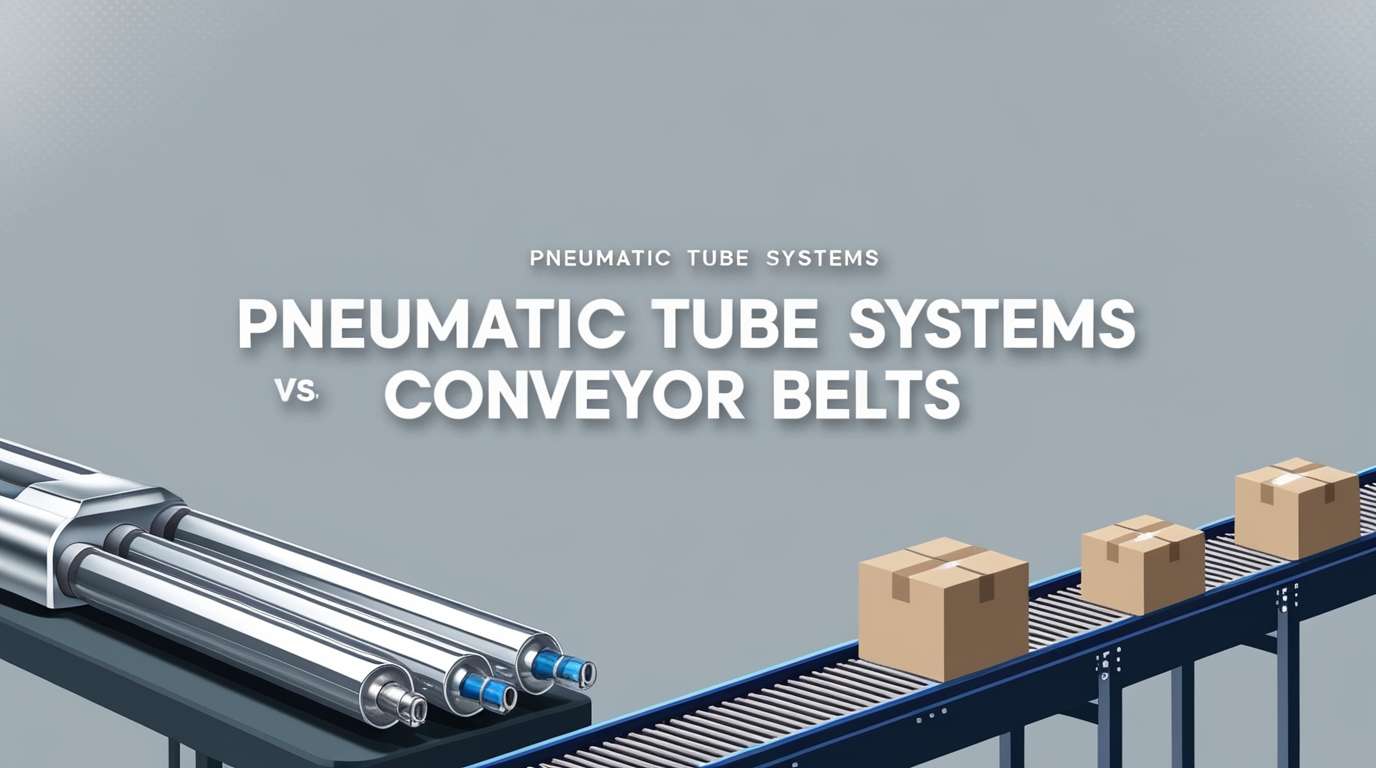
If you buy a conveyor for a job that is mostly point-to-point and spread across multiple floors, you can end up with a long line that is hard to route, slow to change, and expensive to expand. If you buy a pneumatic tube system for items that are too large, too heavy, or too variable, you can end up with jams, workarounds, and frustrated operators who go right back to “just walking it over.”
This guide is designed to help you choose correctly between two categories that can sound similar in early vendor conversations, but behave very differently once installed: pneumatic tube systems and conveyor belts. The goal is clarity, risk reduction, and time savings before you spend weeks on quotes that don’t match your actual need.
A pneumatic tube system moves carriers through tubes using air pressure or vacuum. The item is loaded at a station, and the system transports it , and the item arrives at another station where someone removes it.
Pneumatic tubes tend to work well when the items are small, and the destinations are spread out. Fitting a facility with a pneumatic system means fewer touchpoints and a speedy transit from one location to the next that is powered by air pressure. However, buyers are often confused and assume that the tube system is a general replacement for “moving anything.” It is not. Carrier size, acceptable item fragility, and consistency of what you send matter are crucial things to consider before you opt for these.
A conveyor belt system moves items along a designed route using belts or rollers that are supported by frames, drives, and controls. Items can be transferred from one section to another, merged, diverted, buffered, and delivered to workstations or automated equipment.
Conveyors are a great choice when you have steady volume, larger items, or a process flow that benefits from a predictable physical line. Conveyor belts are a regular feature of packaging, warehousing, distribution, and manufacturing operations where you want to move cartons, or assemblies without the hassle of manual carrying.
Where buyers get into trouble is underestimating how “fixed” a conveyor is. Once installed, changing routes and adding endpoints can be more disruptive than expected, especially in tight facilities.
What you’re comparing
Pneumatic tube systems
Conveyor belts
What it means for you
How work moves best
Point-to-point deliveries Continuous flow on a set path If you “send” items between departments, tubes fit. If items “travel” through a process, conveyors fit.
Small, consistent items in a carrier Wider range of sizes and weights Big or variable items usually push you to conveyors. Small, standard items keep tubes simple.
How fast it feels
|
What you’re comparing |
Pneumatic tube systems |
Conveyor belts |
What it means for you |
|
How work moves best |
Point-to-point deliveries |
Continuous flow on a set path |
If you “send” items between departments, tubes fit. If items “travel” through a process, conveyors fit. |
|
What you can move |
Small, consistent items in a carrier |
Wider range of sizes and weights |
Big or variable items usually push you to conveyors. Small, standard items keep tubes simple. |
|
How fast it feels |
Fast end-to-end for a single delivery |
Steady speed, tied to line traffic |
Tubes win for urgent one-offs. Conveyors win for steady volume all shift. |
|
Volume profile |
Good for bursts |
Good for nonstop throughput |
If demand spikes and drops, tubes cope well. If demand stays high, conveyors shine. |
|
Space needed |
Uses walls/ceilings; small floor impact |
Takes floor/aisle space; needs guarding |
Tight floor space favors tubes. Open corridors favor conveyors. |
|
Ease of changing the route |
Easier to add endpoints, within limits |
Changes often mean physical rework |
If your layout changes often, conveyors can become a headache. Tubes are usually less disruptive. |
|
Seeing the item while it moves |
Enclosed and out of sight |
Visible on the line |
If you must watch, handle, or intervene mid-route, conveyors help. If you want enclosed transport, tubes help. |
|
Damage risk |
Depends on fit and item toughness |
Depends on transfers and belt design |
Neither is “safe by default.” The details decide. Poor fit or rough transfers cause problems. |
|
Security and control |
Strong station control and logged sends/receipts |
Possible, but more open access |
If chain-of-custody matters, tubes often reduce risk and procedural burden. |
|
Cleanliness and exposure |
Items stay enclosed in carriers |
Items are exposed unless contained |
If exposure is a concern, tubes can simplify control. Conveyors may need extra containment steps. |
|
Safety focus |
Fewer pinch points on the route; noise can matter |
Pinch points and guarding are central |
Conveyors demand strict guarding and lockout habits. Tubes reduce some hazards but add station and noise considerations. |
|
Maintenance “feel” |
Issues can be hidden; troubleshooting can be less obvious |
More mechanical parts; problems are often visible |
Conveyors are often easier to diagnose by sight. Tubes can be reliable, but failures can be harder to spot. |
|
Systems integration fit |
Best for station-based confirmation workflows |
Best for in-line scanning, sorting, buffering |
If your value is “confirmed delivery,” tubes fit. If your value is “process control on the line,” conveyors fit. |
|
Scaling later |
Add stations/routes if designed for it |
Add zones/lines if space allows |
Tubes often scale with less floor disruption. Conveyors scale well when you planned the footprint from day one. |
|
The most common regret |
Items don’t fit, jam, or create exceptions |
The line blocks space and is hard to change |
These regrets are predictable. Match the system to the transport pattern first. |
Start with what you are moving, not what you are automating.
If what you move is compact and fits cleanly into a standardized carrier, pneumatic tubes are a better fit. If what you move is bulky and includes larger cartons, or products that change shape and size over time as they are worked on then conveyors are often the safer option. When buyers skip this step, they waste time collecting quotes that look comparable on paper but fail during detailed design because the physical reality does not match the concept.
Map the “from-to” layout in plain terms.
If your map looks like many-to-many department handoffs across a building, especially across floors, tubes often align better because they excel at direct delivery between endpoints and do not need a separate floor corridor. If your map looks like a single dominant flow from receiving to storage to packing to shipping, conveyors are better suited to that layout because they provide a stable backbone where items can accumulate and be processed in sequence.
This step reduces the risk of building a system that technically moves items but does not match how work actually moves.
Decide whether you need delivery confirmation or in-line processing
If your pain is “we don’t know where it is, who has it, and when it arrived,” tube systems can solve that at the station level because each send and receipt can be controlled as a transaction.
If your pain is “we need to scan, weigh, divert, and buffer items as part of a process,” conveyor systems typically support that more naturally because they are designed for continuous in-line logic.
This is where many early quotes become misleading. Vendors can promise integration on both sides, but the effort, complexity, and ongoing operational discipline are different.
If your primary problem is frequent, speedy movement of small items that saves time, and the locations are far apart, especially across floors, you should lean toward a pneumatic tube system. It is often the more direct way to cut travel time, reduce touchpoints, and improve delivery accountability for discrete items.
But if you are faced with the dilemma of moving a steady volume of larger items along a process, especially where scanning, buffering, sorting, or packing are part of the workflow, you should lean toward a conveyor belt system. It is usually the more reliable backbone for continuous flow and higher sustained throughput.
The decision becomes risky when you choose based on the wrong signal, such as picking the system that appears cheaper in an early quote, or the one you have seen in a different industry. Your safest path is to match the system to the transport pattern first, then confirm that the items, facility, and operational expectations fit that category.
If you buy a conveyor for a job that is mostly point-to-point and spread across multiple floors, you can end up with a long line that is hard to route, slow to change, and expensive to expand. If y...
READ FULLPneumatic systems are pretty straightforward in design. Compressor. Regulator. Valve. Cylinder. Done. And then one cheap tube turns your tidy schematic into a leak hunt at 2 a.m. Tubing material is...
READ FULLPU sheets, or polyurethane sheets, are vital for protecting industrial equipment and extending its lifespan. These multifunctional materials are better, more resilient, and more wear-resistant, as ...
READ FULL