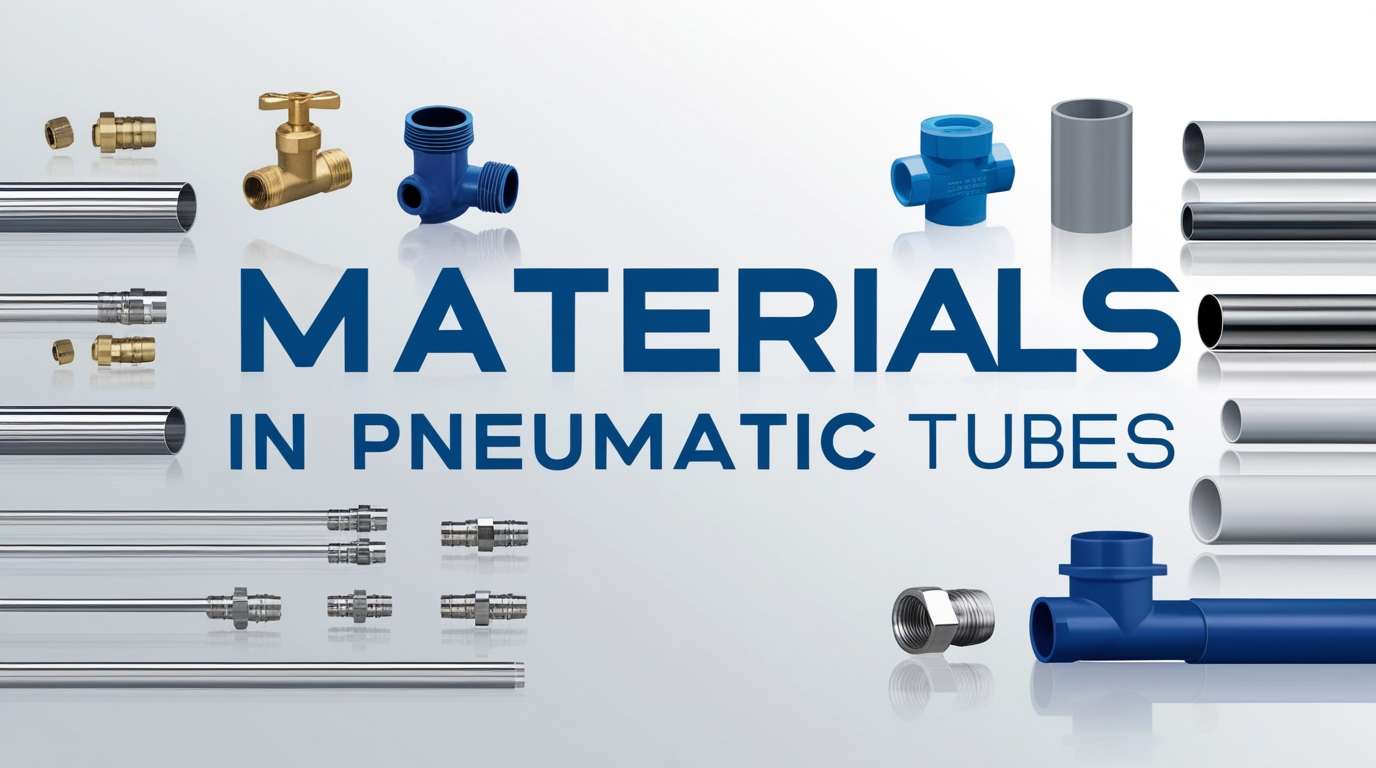
Pneumatic systems are pretty straightforward in design. Compressor. Regulator. Valve. Cylinder. Done. And then one cheap tube turns your tidy schematic into a leak hunt at 2 a.m. Tubing material is not a cosmetic choice, and its nature affects multiple aspects of pneumatic operation. This can be pressure stability, motion behaviour, chemical survival, and even maintenance events. Choose well, and the whole system will operate seamlessly. Choose poorly, and the tube quietly sabotages the entire line. A host of issues occur, like kinking, cracking, swelling, or bleeding air, like a slow puncture in a tire.
In this blog, we will deeply analyse the pros and cons of four common materials that comprise various types of pneumatic systems, namely, polyurethane (PU), nylon (polyamide), PVC, and rubber. Each one has a personality. Each one has a failure style. The goal is not “the best.” The goal is “the best for your exact requirements.
Pressure Parameters
First, how much pressure and what kind of cycling? Static distribution lines can behave like polite adults. Moving actuator drops behave like toddlers on espresso, constantly bending, twisting, rubbing, and occasionally yanking.
Thermal Stability
What temperature range actually happens in the tube, during operation? Ambient might be 25∘C. But the temperature is not uniformly constant along the entire tube system. The machine corner near the oven might be 55∘C.
Surrounding Environment
What does the environment splash, mist, or breathe onto the tube? Different pneumatic systems have different liquids like oils, coolants, solvents, ozone, UV. This is where “works fine” is not enough.
Routing
Fourthly, how tight is routing? Excessive bends can affect tube flexibility and if you force a stiff tube around a sharp corner, damage will occur. Permanently.
Finally, what fittings are you using in your setup, and how forgiving is installation? Push-to-connect setups can be easy or brutal, depending on tubing hardness and cut quality. Nevertheless, teams ignore this until leaks show up like uninvited guests.
PU Tubing:
PU tubing is highly preferred for moving pneumatics for a reason. Its flexibility and bendability mean a high tolerance for repeated motion without developing any cracks. If your setup includes moving grippers, pick-and-place arms, or any application where the tube must move all day relentlessly, PU usually earns first consideration.
PU is also abrasion-resistant and that matters because real routing means contact with rough surfaces. Tubes rub on brackets, zip ties, and whatever sharp edge someone forgot to deburr. PU can endure that daily friction and remain undamaged.
However, PU is not invincible. Some oils, solvents, and aggressive chemicals can swell it, or weaken it over time. That slow degradation creeps up gradually and just silently changes properties until fittings stop sealing or leaks start happening. Furthermore, another issue that develops is hydrolysis. This becomes a concern in wet environments, depending on the exact polyurethane formulation.
So, choose PU when motion and flexibility are the top priorities, and then confirm chemical exposure for your suitability.
Nylon Tubing:
Nylon tubing is the better fit when you want structure. There are several reasons for this. It tolerates higher pressures in many common pneumatic application systems.
If you’re building compressed air distribution runs inside panels, around machines, or along frames where the tube isn’t constantly flexing, nylon becomes attractive. It’s less flexible than PU. This characteristic can help with clean routing and reduced snagging. Moreover, nylon’s dimensional stability can support reliable sealing when paired correctly with push-to-connect fittings and proper cuts.
But stiffness has its drawbacks as well. Nylon resists bending, so laying these tubes in tight corners can create stress points. Over time, especially in colder temperatures, that stress can turn into cracks. The kind that only leaks when the machine vibrates just right.
Moisture absorption is also nylon’s weak point. It absorbs water from the environment, which may slightly alter flexibility and dimensions. In many plants, this is manageable. But, in some high-precision situations, this tends to become a performance issue.
In short, nylon is your friend for higher pressure and cleaner static routing. You will be successful so long as you respect bend radius and don’t force the tube in unnatural positions that take a toll on its structural integrity.
PVC Tubing:
PVC is another popular material that is commonly found in pneumatic tubing systems worldwide. The main reason is that it's easy to manufacture and quite inexpensive. Still, PVC delivers well in light-duty, low-pressure setups. In these situations, the environment is gentle and expectations are forgiving.
However, PVC has its limits. Excessive temperature swings can harden it. Cold can make it brittle. Some chemicals and oils can attack plasticisers, which can lead to stiffening, cracking, or surface changes. If the pipe layout is exposed to the outdoor environment, it adds another twist: UV degradation. PVC is not meant for outdoors unless a special UV-resistant variety is made.
Utilise PVC when cost is the driver and the application is genuinely mild. If downtime is expensive or pressure is high, PVC is a bad option.
Rubber Tubing and Hoses: The Rugged Veteran
The phrase rubber tubing can be misleading because rubber is not one material but has multiplevarieties. NBR (nitrile) behaves differently than EPDM. A reinforced rubber hose behaves differently than soft rubber tubing. So you don’t “choose rubber” as much as you choose a rubber type and construction that matches the threat. Rubber excels in harsh, physical environments. It tolerates vibration well and flexes with a heavy, stable feel. It is also tear-resistant and accustomed to rough handling. In shops where equipment gets bumped, dragged, and occasionally mistreated, rubber hoses often survive better compared to rigid tubing.
Nevertheless, rubber can age with long-term use. Ozone and UV can cause surface softening. Certain oils can swell certain rubber compounds. Permeation can be higher than you expect, meaning slow air loss is not impossible. Also, rubber can be bulkier and heavier, which can matter in moving assemblies.
The final take is that rubber shines for ruggedness, vibration tolerance, and industrial toughness provided you select the right compound for oils, weather, and temperature.
You can buy premium tubing and still fail if your cuts are sloppy. Push-to-connect fittings demand clean, square cuts. While, oval tubing ends don’t seal well. Over-tight bends near fittings create stress and micro-leaks. Furthermore, mixing a very soft tube with a fitting designed for stiffer materials can cause pull-out risks if the tube gets tugged.
Treat installation like a quality process, not a casual task. Tubing material selection is only half the job. The other half is execution.
* PU often fails due to swelling, softening, or gradual degradation from unfriendly chemicals, and to kinking if routing is careless.
* Nylon tends to fail via stress cracking. This usually occurs under repeated bending, cold, or incompatible chemical exposure.
* PVC often fails by becoming brittle, cracking in colder conditions, or degrading under oils/solvents and UV.
* Rubber can fail through ageing, surface cracking from ozone/UV. Swelling from incompatible oils, is also a major culprit of failure.
When you know the failure style, you can predict the breakdown event beforehand and that is vital for a strategic approach.
Priority-wise start with motion. Then pressure. Then environment. Then temperature. Then fittings. In that order. PU for movement. Nylon for higher-pressure, tidy static runs. PVC for genuinely mild, budget-focused applications. Rubber for rugged, vibration-heavy, physically abusive environmentscompound selected with intent. Tubing is small. The consequences are not.
If you buy a conveyor for a job that is mostly point-to-point and spread across multiple floors, you can end up with a long line that is hard to route, slow to change, and expensive to expand. If y...
READ FULLPneumatic systems are pretty straightforward in design. Compressor. Regulator. Valve. Cylinder. Done. And then one cheap tube turns your tidy schematic into a leak hunt at 2 a.m. Tubing material is...
READ FULLPU sheets, or polyurethane sheets, are vital for protecting industrial equipment and extending its lifespan. These multifunctional materials are better, more resilient, and more wear-resistant, as ...
READ FULL