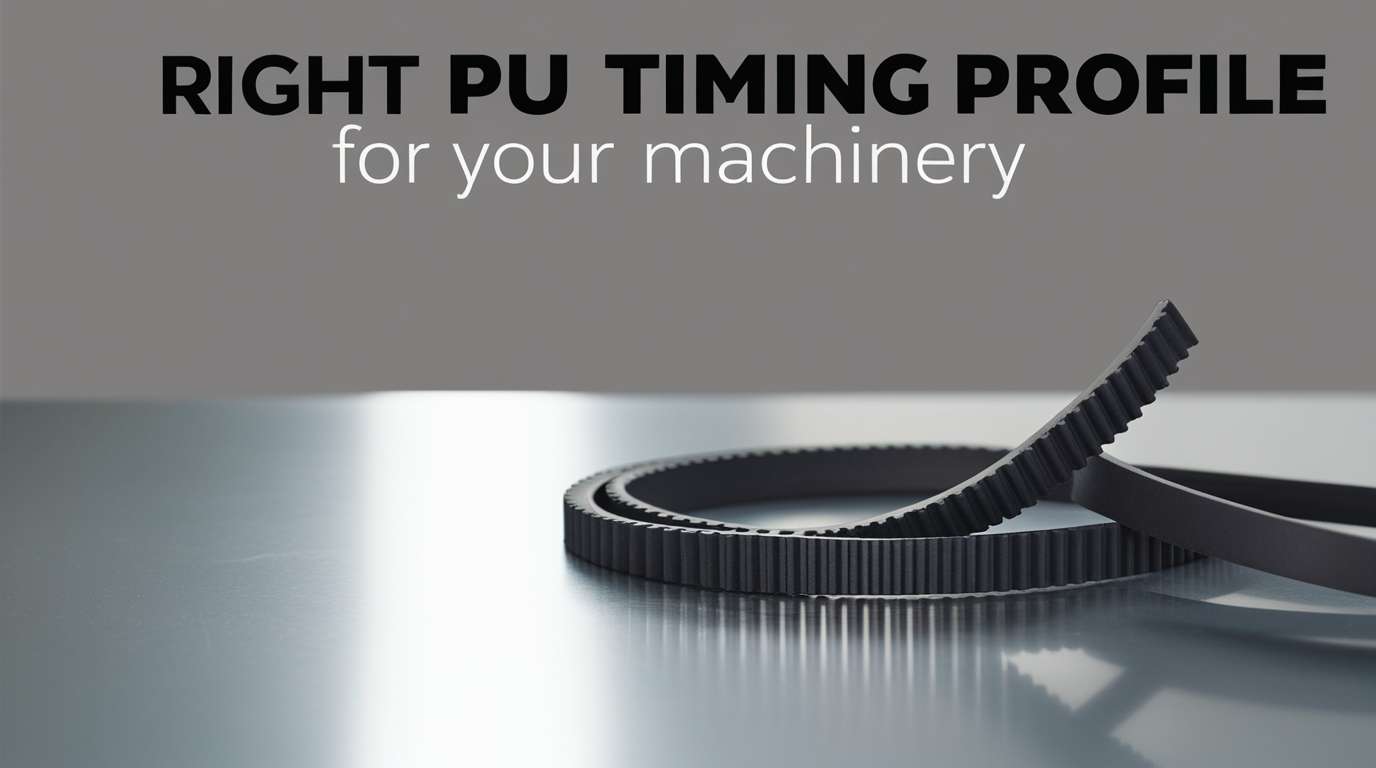
PU timing belts are essential in industrial machines. Such belts convey power and motion among the various components of equipment. Selecting an incorrect belt profile can lead to equipment failure, production delays, and costly substitutions. Knowledge of the correct timing belt selection time helps ensure smooth machine operation and prolongs the machine's life.
Basic Description
PU stands for polyurethane, a powerful synthetic compound. PU timing belts have teeth on the inner face that interlock with pulleys. This design with teeth prevents movement without an object to hold it in place and is used for precise timekeeping among the moving parts.
Why They Matter
Timing belts are also more accurate in their positioning than smooth belts, which may slip. This precision is necessary where you have an application that needs some synchronized movement. Due to their use in machines such as conveyor systems, packaging machines, and automated assembly lines, timing belts are reliable components.
What Profile Means
The profile is the shape and size of the timing belt's teeth. The shapes, heights, and pitches of teeth vary across profiles. The profiles are designed to accommodate specific load-bearing capabilities and speeds.
Common Profile Types
There are several conventional profiles in the industry. The most common trapezoidal profiles include T5, T10, and T20. In the HTD profile, the teeth are curved to enhance load distribution. AT profiles provide a high exhaust to ensure demanding use. The types have various machinery requirements.
Calculating Load Demands
Know the amount of power the belt needs to carry. This is based on the motor's horsepower, the operating speed, and the weight being hauled. Greater-power applications require belts with larger, more powerful teeth.
Safety Margins
A belt should never be taken at its specific capacity; it should always be taken at its required capacity. Add a minimum 20 percent buffer to the calculated demands. This buffer considers both short-term overloads and wear-out, as well as other unforeseen stresses.
Speed Ranges
Belt profiles have varying operating speed ranges. Smaller pitch belts are also most suitable at high rates, although they have lower loads. The larger pitch belts handle heavy loads, but they are slower.
Speed and Vibration
Vibration and heat are produced in high-speed operations. Speed profiles are developed that contain special shapes that minimize these issues. Maximized recommended speeds in the specifications of the check manufacturers.
Physical Dimensions
Determine the available space on the pulley and the belt. The small profiles require smaller pulleys and can fit into smaller areas. The bigger the profile, the bigger the pulley, but the stronger it is.
Center Distance
The pulley distance determines the belt selection. Small center distances restrict choices to smaller profiles. The longer spans will offer greater flexibility in profile choice but may require additional support.
Tooth Engagement
The pulley groove profile should match the belt profile. The T10 belt can only fit in T10 pulleys. Incorrect profiles lead to unsuccessful involvement, clutter, and untimely failure.
Minimum Pulley Size
All belt profiles possess a minimum recommended pulley diameter. Small pulleys lead to excessive bending stress and a short belt life. Use the manufacturer's minimum size guidelines.
Temperature Factors
PU timing belts can withstand a wide temperature range, but the extremes negatively affect performance. Standard belts operate in -30 degrees Celsius up to 80 degrees Celsius. In cases of necessity, special compounds are used for higher or lower temperatures.
Exposure to Chemical
Consider any chemicals, oils, and solvents that are in the working environment. Normal PU is resistant to a range of substances, though certain chemicals may require specifically designed belts. Prior to choice, determine the compatibility of chemicals.
Moisture and Humidity
Wet conditions influence some of the materials used in belts. PU tends to be very moisture-resistant, though components regularly exposed to water may require special treatments or alternative materials.
Positioning Accuracy
The fine-pitch profiles are required where fine placement is required. The smaller teeth have a finer incremental movement. This precision is usually needed in packaging machines and printing equipment.
Backlash Concerns
The slight movement that occurs when the direction reverses is called backlash. Less backlash is experienced with tighter-fitting profiles that have greater tooth engagement. Critical positioning programs are intolerant of play.
Steady vs. Variable Loads
Constant and steady loads are contrasted with the fluctuating or shock loads. Curved tooth profiles, such as HTD, are better at concentrating variable loads than trapezoidal teeth. Correlate the profile to the load characteristics.
Direction of Load
Consider the loading action, which is either mostly pulling or pushing. Some profiles perform better under tension, while others perform better under compression. The application determines the most significant issues.
Belt Width Options
Timing belts are available in several profile widths. The broader belts have greater capacity at the expense of increased space and higher pulleys. Slim belts are tighter and have a capacity limit.
Multiple Belt Systems
Under high loads, parallel-operating belts may be necessary. This will be based on standard profiles rather than tailored wide belts. Ensure an even distribution of load across all belts in those systems.
Replacement Ease
Think of the trouble of changing the belt. Specific machines are so well designed that they can change the belt with ease, whereas others require many disconnections. Select strong passwords for installations that are hard to access.
Inspection Capability
Belts should be checked for wear and tear. Worn-out profiles are a clear way to detect problems before failure. Tooth wear is visible through transparent or light-colored PU.
Underestimating Loads
Numerous failures are due to underestimating the actual loads. Calculate acceleration forces, friction, and loss of efficiency. Practical circumstances are usually higher than the theoretical ones.
Ignoring Environment
Problems arise when not thought out in advance with temperature extremes, chemicals, and moisture. These have a profound impact on the performance and life of belts.
Wrong Tension
Correct profile selection will be fruitless if the tension is not addressed. Excessively loose results in tooth jumping. If it's too tight, the bearing is overloaded and wears out quickly. Aspects of Tensioning Techniques.
Conclusion
The selection of PU timing belt profile has to be mind-systematic and consider various factors. It depends on power needs and operating rate, space considerations, and the environment. Knowledge of multiple profiles and their abilities helps match belts appropriately.
It will save one a lot of money by taking the time to evaluate needs carefully and to seek expert advice where necessary. The right belt profile ensures efficient machinery operation, reduced maintenance, and optimal equipment utilization.
If you buy a conveyor for a job that is mostly point-to-point and spread across multiple floors, you can end up with a long line that is hard to route, slow to change, and expensive to expand. If y...
READ FULLPneumatic systems are pretty straightforward in design. Compressor. Regulator. Valve. Cylinder. Done. And then one cheap tube turns your tidy schematic into a leak hunt at 2 a.m. Tubing material is...
READ FULLPU sheets, or polyurethane sheets, are vital for protecting industrial equipment and extending its lifespan. These multifunctional materials are better, more resilient, and more wear-resistant, as ...
READ FULL